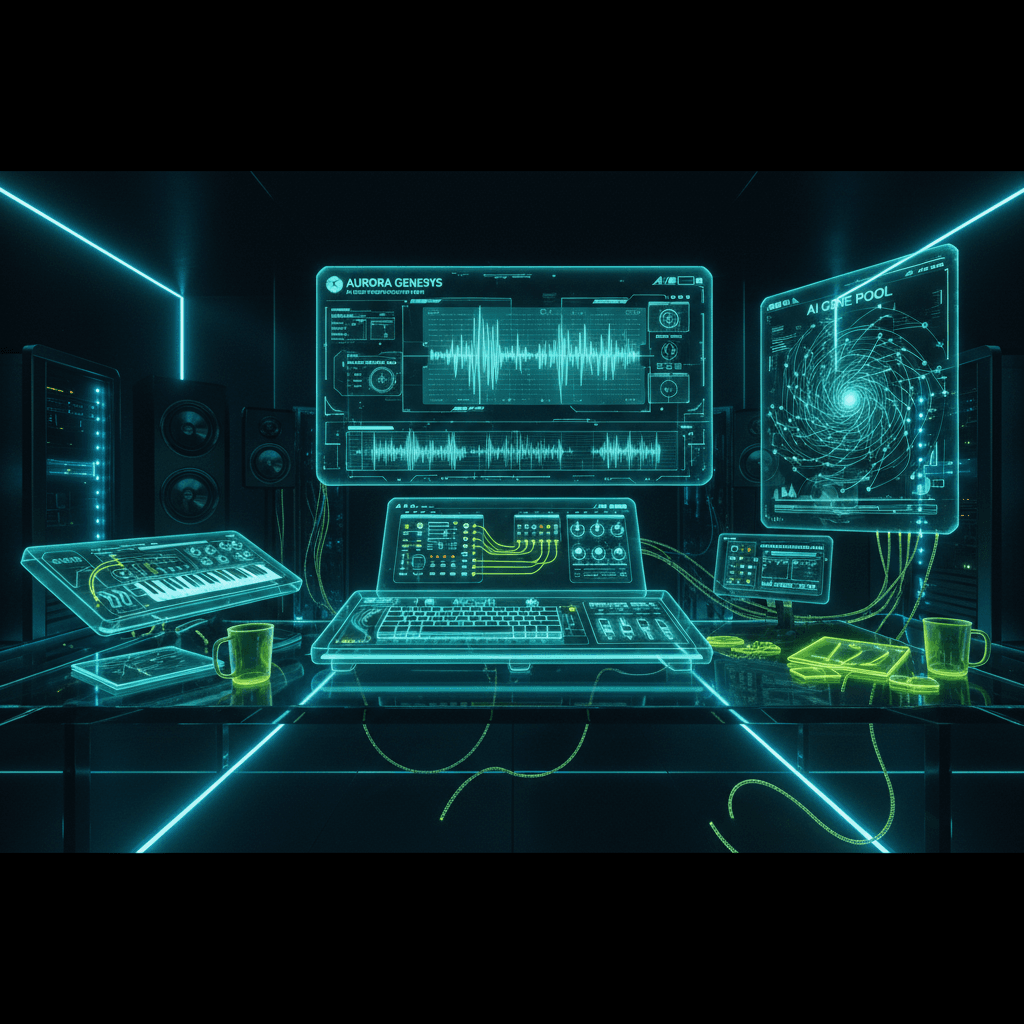
The Landscape Has Changed Permanently
Three years ago, the question of whether AI could produce listenable music was still open. Today it is not a question. Suno, Udio, and a growing ecosystem of specialized tools can produce studio-quality electronic music from a text prompt. The question is no longer whether the tools work. The question is what they do and do not do well, and how to integrate them into a production practice.
This is a guide to the current state of AI music production tools in 2026 — what each major platform offers, where the quality gaps are, and how to use these tools without losing the part of music that makes it worth making.
Suno: The All-Rounder
Suno remains the most versatile of the major AI music platforms. Its strength is range: it handles multiple genres, multiple production styles, and multiple structural formats without requiring the user to understand the technical details.
Best for:
- • Rapid prototyping of song structures
- • Generating multiple variations of a melodic idea quickly
- • Exploring compositional territory that would take weeks to develop manually
Use Suno to generate the initial melodic and harmonic skeleton of a track — then import the stems into a DAW and build the production around them.
Udio: The Electronic Music Specialist
Udio has positioned itself as the stronger platform for electronic music specifically. Its synthesis engines are tuned for the sounds that define synthwave, darksynth, and related genres, and the production quality of its outputs is noticeably higher in these registers than Suno's.
Best for:
- • Electronic music production, genre-specific sound design
- • Generating complete tracks in the synthwave and darksynth range that require minimal post-processing
Custom Models and Fine-Tuned Tools
Beyond the major platforms, a growing ecosystem of custom and fine-tuned models is available to producers who have the technical background to use them. These are models trained on specific genre corpora, specific production styles, or specific sonic signatures.
Best for: Producers who want a specific sound that no general-purpose platform delivers — a signature production style of a specific artist, for example.
Weaknesses: Requires technical setup and ongoing maintenance. Not accessible without command-line or API experience.
The Honest Assessment
AI music tools in 2026 are genuinely useful for specific production workflows and genuinely limited in others. They are not going to replace producers. They are going to change what production means — shifting the skilled work from instrumental execution to curation, direction, and post-production.
The producers who are using these tools most effectively are not treating them as composers. They are treating them as instruments — extraordinarily capable instruments that need to be shaped by a clear artistic vision to produce results that are worth hearing.
That is a fair description of the synthesiser. That is a fair description of the DAW. The AI tool is the same category of thing. It is a new kind of instrument.