The Tool That Everyone Assumed Was Permanent
When Ableton Live established the session view as a paradigm for electronic music production in the early 2000s, it felt like the format had been solved. The DAW — Digital Audio Workstation — became the universal instrument of music production. Everything flowed through it.
Twenty years later, the assumption that the DAW is the permanent centre of music production is being stress-tested in ways that the original architects of the format did not anticipate.
What the DAW Actually Is
The DAW is, at its core, two things: a sequencing engine and a routing matrix. The underlying model is consistent across all implementations — Ableton's session view, FL Studio's pattern-based workflow, Logic's linear timeline.
This model was designed for a world where the human producer was the source of all musical decisions. The DAW's job was to execute those decisions with precision. The producer was the author. The DAW was the instrument.
That model is now outdated.
The AI Disruption of the Production Workflow
When Suno and Udio can produce complete, mixed, mastered tracks from a text prompt, the question they raise is: what is the DAW for, now?
The answer is not straightforward because the DAW is not one thing. It is two things. And AI disrupts one of them while leaving the other intact.
- • The sequencing engine: AI is making this largely irrelevant for large portions of production. You no longer need to sequence events in time when the AI can generate coherent musical sequences from a description.
- • The routing matrix: Still essential. The ability to direct audio signals between processing units, to apply effects chains, to control the spatial and dynamic characteristics of a mix — this is the part of the production process that AI does not yet do reliably.
What This Means for the DAW
The DAW is not dying. It is being reassigned. Its function is shifting from being the site of musical creation to being the site of musical refinement.
In 2026, the most effective production workflow looks like this: generate with AI, refine in the DAW. The DAW is no longer where the track starts. It is where the track gets finished.
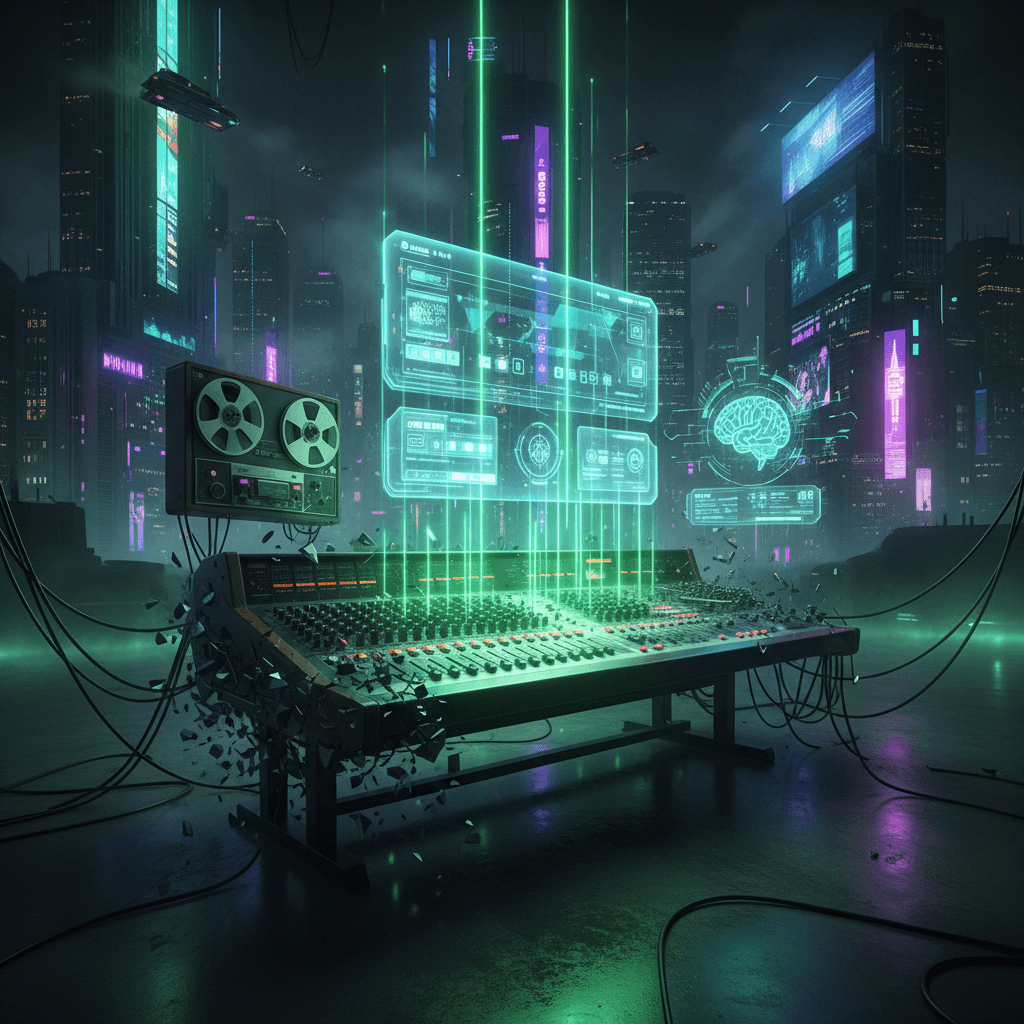
This is actually a return to an older model. Before the DAW became the universal tool, mixing engineers worked in studios with hardware mixers and tape machines. They did not compose. They refined. The DAW absorbed their function. Now AI is absorbing the composition function, and the DAW is returning to its mixing-and-refinement role.
The New Definition of Producer
In the post-AI production environment, "producer" is going to mean something different than it has meant for the past fifteen years.
The old definition: the person who makes all the musical decisions about a track, from composition to final mix.
The new definition: the person who shapes the output of an AI system into a release-quality track.
The producer as director rather than composer. The producers who can direct AI-generated output toward a specific sonic vision are going to be the most effective music makers of the next decade.