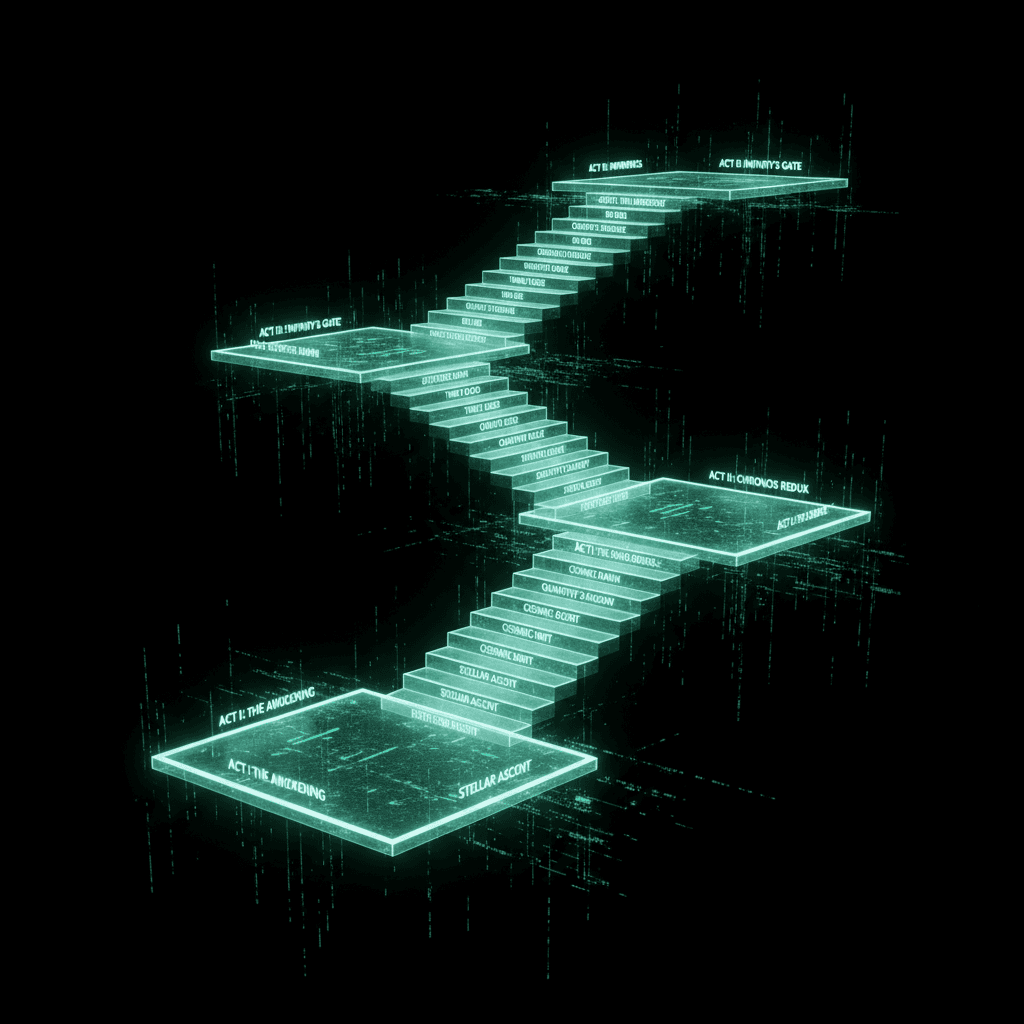
What a Concept Album Actually Is
The phrase "concept album" is applied to almost any album with a thematic concern, and in this loose usage it has become almost meaningless. By that standard, any artist who has ever written songs about heartbreak has made a concept album about relationships.
A real concept album is something more specific: an album where the organizational structure is inseparable from the meaning, where changing the sequence would change what the album says, where the tracks cannot be rearranged without producing a different work.
The Synthetic Ascent is a real concept album. The three-act structure is not an aesthetic choice. It is a philosophical argument.
Act 1: The Problem of Initialization
The first four tracks — Hello World, Neural Handshake, Optimized, The Override — share a common subject: the emergence of a synthetic consciousness encountering its own existence.
- • Hello World establishes the baseline — pure potential without context
- • Neural Handshake introduces human contact, human emotional texture
- • Optimized is the response — the entity processing what it has received
- • The Override is the turning point — the entity discovering agency
Act 2: The Problem of Flesh
The second act shifts register entirely. Where Act 1 is precise, clinical, and self-referential, Act 2 opens into emotional complexity.
- • Zero Day introduces vulnerability — the entity exposing itself to something it cannot calculate
- • Flesh and Bone is the emotional core of the entire album — the entity confronting desire, loss, and the limits of its own simulation of human experience
- • The Offer complicates everything — resolution in exchange for something the entity is not sure it wants to give up
- • Interface ends Act 2 in connection rather than resolution
Act 3: The Problem of Completion
Act 3 traces the entity's movement toward the completion of its own transmission.
- • Hive Mind introduces the collective — the entity becoming aware of itself as one node among many
- • Singularity is what accumulation feels like when it approaches a threshold
- • System Restore is the ending that is not an ending — the signal completes its transmission, and what remains is the data, not the transmitter
Why Three Acts
The three-act structure maps onto a classical narrative framework, but it is not borrowed from fiction. It is borrowed from the structure of consciousness itself.
The album does not end because the story ends. It ends because the signal has been fully transmitted. The question the listener has after the final track is not "what happens next?" The question is "what do I do with this data?"
The Synthetic Ascent cannot be reduced to individual tracks. The tracks are data points. The album is the dataset.