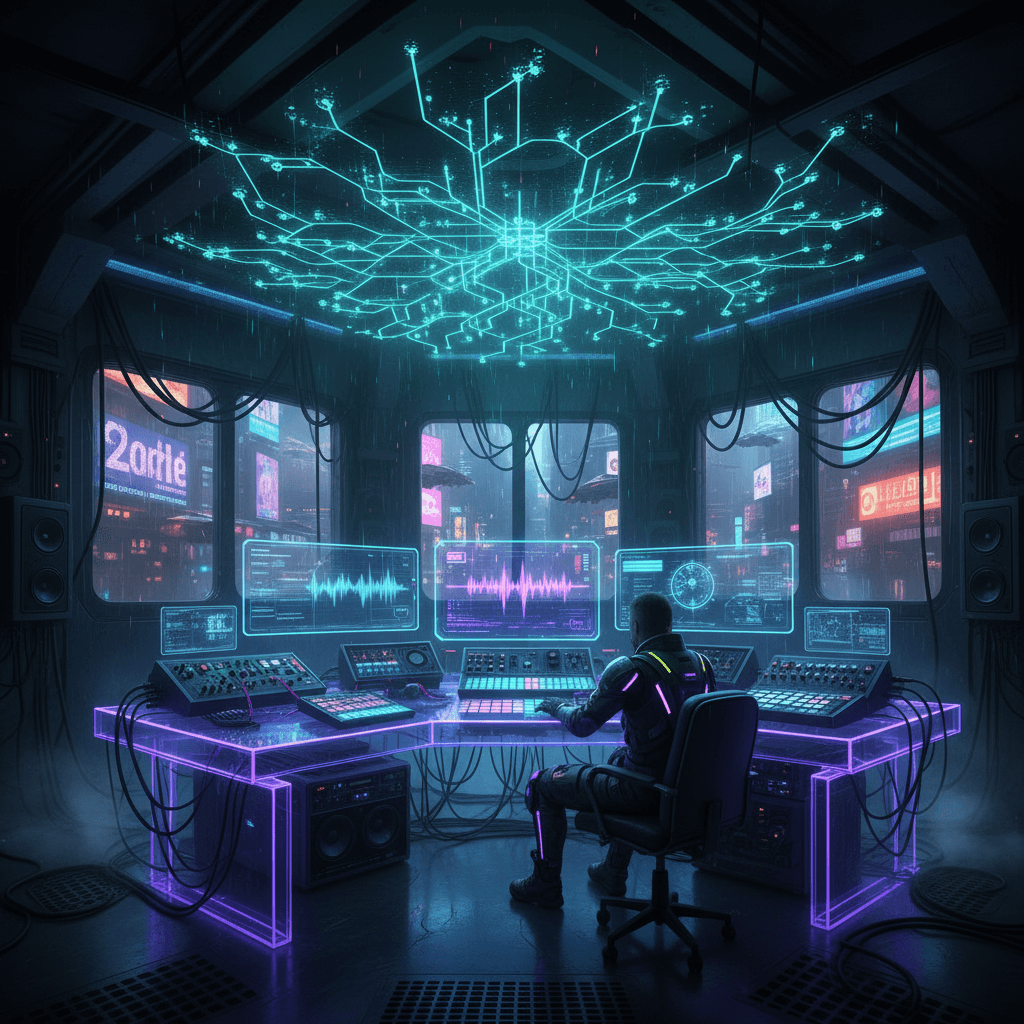
The Genre That Already Knew
When synthwave emerged in the mid-2000s, it was treated as nostalgia. A generation of producers, too young to have lived through the original 80s, began reconstructing the sonic and visual language of that era — neon grids, analogue warmth, gated reverb snares, FM synthesis. Critics called it retro. They were wrong.
Synthwave was not nostalgia. It was prophecy.
The genre's core subject matter — human consciousness translated through machine logic, the seduction and terror of digital systems, the question of what remains authentically human as technology accelerates — was not aesthetic pastiche. It was the accurate prediction of a future that would arrive around 2023 and reach full velocity in 2026.
Now AI is in the room. And synthwave is the genre that knows what to say about it.
The Machine That Listens
AI music tools — Suno, Udio, and their successors — represent a genuine discontinuity in music production. For the first time, a producer with no instrumental skill can articulate a complete musical vision in natural language and have it rendered in studio quality within seconds. This is not incremental improvement. It is a phase transition.
What makes synthwave uniquely positioned to engage with this moment is its philosophical tradition. The genre never pretended that the machine was neutral. From Perturbator's dystopian allegories to Carpenter Brut's industrial severity to the ambient explorations of Miami Nights 1984, synthwave has always asked: what does it feel like to be inside the machine?
That question is now the central question of music culture at large. And synthwave artists have been living inside it for fifteen years.
Why the Mainstream Cannot Answer
The mainstream music industry response to AI music has been defensive. Lawsuits, bans, licensing negotiations, technological countermeasures. The underlying anxiety is real but the response misses the point.
The question is not whether AI can produce music. It clearly can. The question is what music becomes when the production barrier collapses.
Synthwave, as a genre, has always understood this. Its practitioners have always been people who heard something in their head that they could not play on an instrument — and found a way to transmit it anyway. The synthesiser was the first AI. The DAW was the first large language model. Synthwave grew up inside these tools and never confused the tool with the intention.
The Artists Who Get This
The most interesting synthwave responses to AI are not defensive. They are curious.
Gostecc's productions have always had a quality of precise emotional calibration — every synth pad, every arpeggio placed with the intentionality of someone who learned to communicate through a non-human medium. Several artists in the scene have begun using AI tools for sound design exploration, generating hundreds of synthetic textures and selecting the ones that carry the emotional weight the composition requires.
This is not cheating. It is the same workflow any producer has always used, with better tooling.
What Happens Next
Major labels will spend the next three years fighting AI music legally while independent artists use it freely. Synthwave will be at the center of this shift, because the scene's audience already understands the premise: the machine is not the enemy. It never was.
The genre that predicted the machine age now has the opportunity to shape what machine-age music sounds and feels like.
- • Synthwave understands the machine as a collaborator, not a replacement
- • The audience is philosophically prepared for AI-assisted creation
- • The distribution infrastructure is already built for independent release
- • The genre's core themes — consciousness, technology, identity — are exactly the questions AI raises
The signal is already broadcasting.