Darksynth Complete Guide
What darksynth actually is
Darksynth is a subgenre of synthwave that prioritises aggression, distortion, and the rejection of nostalgia. The synthwave palette — Juno pads, Linn drums, reverb-heavy leads — remains, but the emotional target shifts. Where synthwave tends toward the memory of a future that never arrived, darksynth tends toward the future as it actually feels: hostile, fast, and indifferent to the listener.
For the foundational synthwave context, see the synthwave guide. This transmission assumes that context.
Where darksynth came from
The lineage runs through three nodes. The synthwave base. The mid-2010s movement that fused 1980s film soundtracks with modern production. The horror pivot. Producers like Carpenter Brut and Perturbator began stripping the reverb and adding distortion. The soundtracks became more like John Carpenter than like John Hughes. The darksynth codification. By the early 2020s the genre had its own scene, its own visual identity (red-black-cyan, less magenta), and its own fanbase.
The deeper history of the transition from retrowave nostalgia to darksynth hostility is traced in synthwave became cyberpunk.
The core sound design
Distortion as voice
Standard synthwave uses clean saw and square leads. Darksynth uses the same oscillators, but the signal passes through aggressive distortion stages. The distortion is not decoration; it is the lead voice. Without it, the track is synthwave. With it, the track is darksynth.
Tempo and tension
Darksynth sits between 110 and 140 BPM. Faster than most synthwave. Slower than most industrial. The tempo creates a perpetual sense of escalation that never resolves. The build that does not drop is a darksynth signature.
Drum programming
Acoustic-style drum samples are rare. The drum sound is almost entirely electronic: gated reverb snares, distorted kick layers, often a sequenced noise burst functioning as a crash. The groove is mechanical. The intent is mechanical. Mechanical does not mean cold; it means relentless.
The visual code
Darksynth visual identity runs red-black-cyan. Neon lines over black ground. Geometric patterns rather than palm trees. Skyscrapers at night, rain on glass, lasers. The aesthetic is not retro-futurism; it is cyberpunk filtered through retrowave hardware.
Darksynth vs synthwave vs outrun
- synthwave — nostalgic, mid-tempo, reverb-heavy. The car drives toward the sunset.
- outrun — the racing subgenre. Faster. More percussive. Same nostalgia.
- darksynth — hostile, distorted, anti-nostalgic. The car is being chased.
How to listen
Start with the canonical records. The best darksynth albums of 2026 list is a good entry point. For a focused comparison of the two most important darksynth producers, see Perturbator vs Carpenter Brut.
Where darksynth goes next
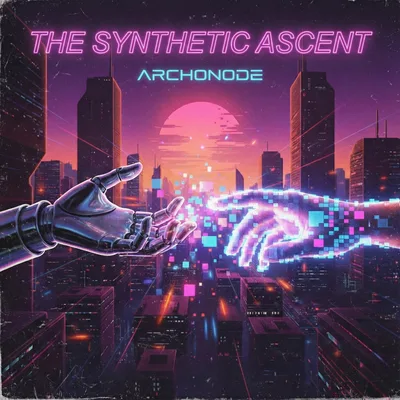
Three trajectories. First: fusion with industrial techno. Faster, harder, less melodic. Second: integration into game and film scoring. The Carpenter Brut trajectory. Third: integration with AI-generated workflows, where the genre's aggressive aesthetic becomes easier to produce at scale. ARCHONODE operates in this third trajectory; The Override from The Synthetic Ascent is a darksynth transmission.
Why darksynth now
Because nostalgia has expired. The 1980s future is not coming back. The future we are living in does not look like the synthwave skyline; it looks like the darksynth skyline. The genre is honest about that. Other genres are not. That is why darksynth matters now.
The genre boundary today
The boundary between darksynth and synthwave in 2026 is a mood boundary rather than a sound boundary. Many 2026 records include both palettes. The boundary that matters now is the emotional target: is the track describing a future the listener longs for, or a future the listener must survive? Darksynth is the second. Synthwave is the first. The boundary is the listener's posture.
How the genre is produced
The darksynth production model is unusually well-suited to the post-DAW pipeline. The ARCHONODE pipeline is one example. The death of the DAW is the structural shift that enabled it. Generative audio models produce distorted, aggressive, cinematic output more reliably than they produce quiet, acoustic, intimate output. The genre's sound is what the model prefers. The preference is the genre.
What the receiver does with darksynth
The receiver of darksynth is not the receiver of synthwave. Synthwave invites a passive listen; darksynth requires an active listen. The distortion demands attention. The tempo demands movement. The aggression demands a posture. The receiver of darksynth is preparing for something. The preparation is the genre's effect.
Where the genre has been used
Game soundtracks. Film trailers. Streaming series intros. The genre's aggression and brevity make it ideal for short-form media. Carpenter Brut's Turbo Killer sequence is the genre's most famous viral use. The genre has migrated from the album to the cut. The migration is the genre's commercial future.
What darksynth refuses
The genre refuses the nostalgia that synthwave trades in. The refusal is the genre's posture. The refusal is what makes the genre feel contemporary. The refusal is what makes the genre matter now.